Northern Lights Dog Sledding in Tromso
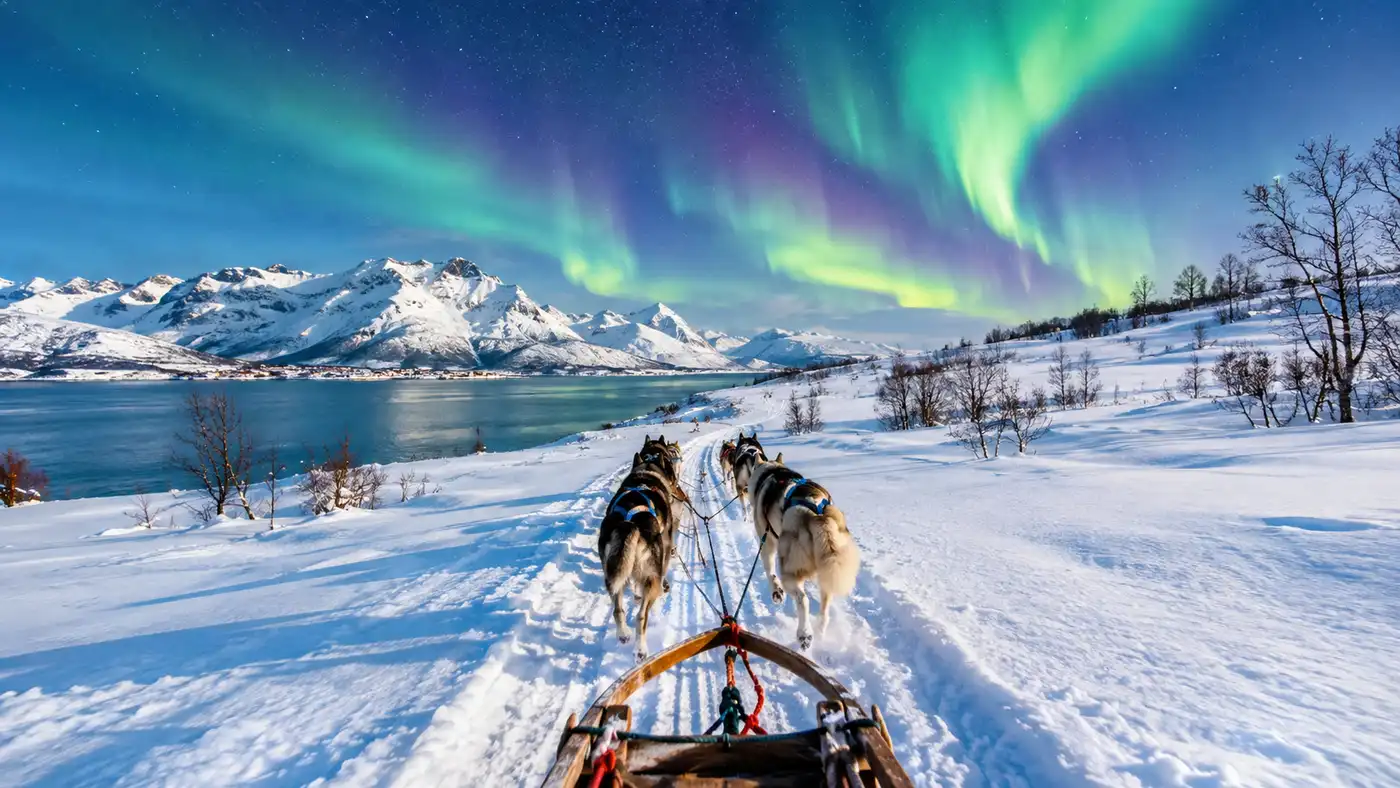
The Arctic night is never pitch black if there is snow on the ground. It turns a deep, reflective slate blue, illuminated by stars and the faint bounce of light from distant settlements over the fjords. Standing on the runners of a wooden sled behind six frantic Alaskan huskies who suddenly stop barking the second the brake lifts, you enter a surreal quiet. Experiencing northern lights dog sledding tromso operators offer is easily one of the most intense ways to see northern Norway. It is cold, physical, slightly chaotic, and if the solar winds cooperate, green ribbons ignite across the sky right over the dog team's pointed ears.
Most travelers arrive in northern Norway expecting either a bus chase or a serene ride in a wooden sleigh wrapped in reindeer skins. The reality of combining sled dogs with an aurora chase sits somewhere between an athletic workout and pure wonder. Sleds require work, dogs have minds of their own, and the Arctic sky plays by its own unpredictable rules. Here is what actually happens out on the trail, how to choose the right nighttime tour, and what nobody tells you about balancing sled driving with skywatching.
Book your dog sledding tromso experience:
What to Expect on a Tromso Dog Sledding Northern Lights Tour
Night runs feel fundamentally different from daytime outings. During the day, your eyes wander across jagged mountain ridges and frozen birch forests. At night, your entire universe shrinks to the 20-foot beam of your headlamp and the rhythm of six pairs of paws pounding hard-packed snow. The dogs love the cold air. When temperatures drop to minus 12 or 15 degrees Celsius, their thick double coats insulate them completely, and they run with noticeably more energy than they do under an overcast noon sky.
Almost all evening tours kick off around 17:00 or 18:00 in Tromso city center. A bus or minibus scoops you up outside the Radisson Blu or the Scandic Ishavshotel and hauls you out into the wilderness. The drive lasts anywhere from 45 to 90 minutes. Getting away from city light pollution is non-negotiable for seeing the aurora borealis, so you will head either west toward the island of Kvaloya or southeast toward the inland valleys near Tamok or Breivikeidet.
Once you arrive at the kennel, the noise hits you first. A yard with 80 or 120 dogs sounds like a roaring stadium when harness bags appear. They bark, leap straight up into the air, and strain against their ganglines because they genuinely want to run. You will be bundled into heavy thermal suits, thick insulated boots, and heavy mittens provided by the operator. After a quick briefing on how to use the foot brake and how to lean on corners, you are assigned a sled.
Note: Aurora sightings are never guaranteed on any sled run. If thick cloud cover rolls in off the Norwegian Sea, you will still enjoy an exhilarating night mushing through snowy valleys, but the sky will remain gray and dark.
If you choose to drive yourself, you will share a sled with a partner. One person stands on the back runners to drive, brake, and kick-pedal up hills. The other sits wrapped inside the canvas sled bag on reindeer hides. Halfway through the 12 to 18-kilometer loop, you swap places. If you are debating between steering yourself or just enjoying the ride, reading our guide on self-drive vs passenger husky tours in Tromso will help clarify the physical demands.
Booking Dog Sledding and Northern Lights Tromso: Tour Options and Costs
Night tours generally cost slightly more than morning runs, partly because they include a hot dinner in a traditional lavvu (Sami tent) around an open fire after the run. You are paying for round-trip transport, all extreme-weather outerwear, a guided sled trek lasting roughly 75 to 90 minutes, and the meal. Prices hover between 2,150 NOK and 2,600 NOK per adult for standard small-group excursions, though private or specialized setups run higher. For a broader breakdown of expenses across the region, see our complete guide to dog sledding in Tromso prices and budget options.
| Tour Style | Location | Approx. Cost (NOK) | Trail Time | Best For |
|---|---|---|---|---|
| Evening Self-Drive | Kvaloya | 2,250 - 2,500 | 70 - 85 mins | Active travelers seeking fjord-edge scenery |
| Inland Wilderness Run | Tamok Valley | 2,350 - 2,650 | 80 - 90 mins | Cold, dry weather and clearer inland skies |
| Guided Passenger Sled | Breivikeidet | 2,100 - 2,400 | 60 - 75 mins | Relaxed skywatching and photography focus |
| Overnight Mush & Camp | Malangen / Tamok | 4,800 - 6,500 | Multiple runs | Maximum aurora chances away from lights |
The difference between coastal spots like Kvaloya and inland spots like Tamok Valley matters immensely for weather. Tromso's coast is moderated by the Gulf Stream, which brings milder temperatures but also ocean humidity and stubborn low clouds. Tamok sits tucked behind jagged alpine massifs. It gets brutally cold - sometimes dropping past minus 20 degrees - but the dry, continental microclimate yields crisp, clear night skies far more often. When booking a tour specifically targeting the lights, looking at where the operator's kennel sits is half the battle.
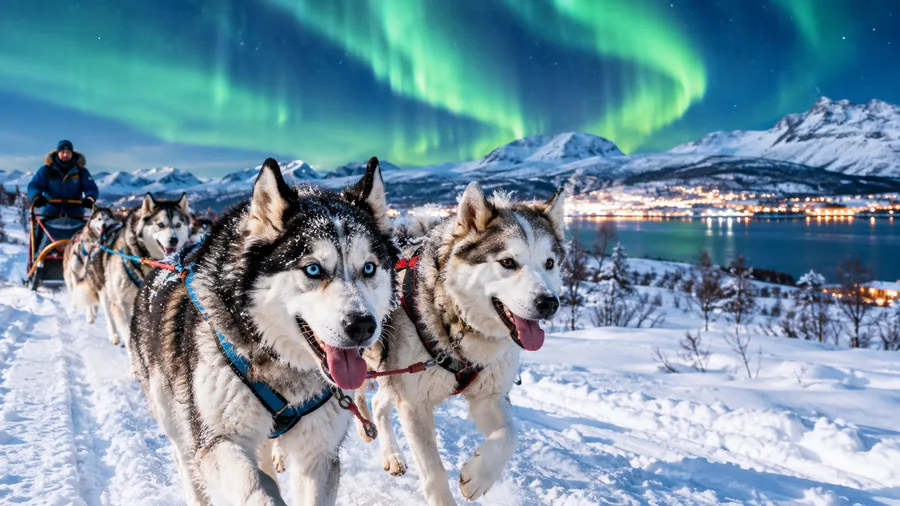
Most commercial tours operate with teams of 5 or 6 dogs per sled. The lead dogs are the intelligent navigators who listen to the guide's vocal commands, while the wheel dogs in the back provide the raw pulling horsepower. Watching their backs move rhythmically under a curtain of shifting green light is something you simply do not forget.
Navigating the Cold: Gear and Practical Preparation
You will get colder than you imagine, especially if you spend the first half of the tour sitting still in the sled basket. The driver works hard, constantly balancing, pumping the brake on downhills, and jogging up inclines to help the team. The passenger, meanwhile, sits entirely motionless inches above the snow, absorbing the ambient Arctic chill and wind speed. Dressing in the right layers beneath the operator's heavy suit is the difference between pure joy and miserable, shivering pain.
- Base layer: 200g or heavier merino wool top and bottom; skip synthetics and never wear cotton.
- Mid layer: thick fleece jacket or a lofty wool sweater paired with loose fleece trousers.
- Feet: one thin pair of wool liner socks, one thick rag-wool outer sock, leaving plenty of toe wiggle room inside boots.
- Hands: thin touchscreen glove liners worn inside the heavy insulated mittens supplied by the basecamp.
- Face protection: a windproof wool neck gaiter or balaclava to pull over your chin and nose against the sled breeze.
Pro tip: Slip chemical hand warmers directly into your boots over your sock toes before pulling on the snow boots; once your toes go numb from sitting in the sled, they will not warm up again until you are inside the tent.
Do not bring a large backpack on the sled. There is no room for it. Sled bags are narrow, and space inside is reserved for you and a reindeer skin. Small crossbody bags or slim waist packs fit under your outer thermal suit nicely. Keep spare batteries, power banks, and your phone tucked into an interior zippered pocket close to your chest. Lithium-ion batteries drop dead in about 12 minutes when exposed to open Arctic air at minus 10.
Book your dog sledding tromso experience:
The Reality of Aurora Hunting by Dog Sled
Managing your expectations is vital when combining these two activities. Here is the unvarnished truth: driving a dog sled requires your eyes on the trail. You must watch the lines to ensure they stay taut, look out for unexpected ice bumps, and keep your distance from the sled ahead. If the aurora borealis suddenly flares overhead in a bright display of purple and green, you cannot simply gaze upward for three minutes while moving. If you lose focus, the sled will drift into a drift, tip over, or run up onto the dogs in front of you.
This is why switching places halfway through is so brilliant. When you are the passenger, you can lean back, point your chin at the zenith, and take in the whole sky. You hear the rhythmic panting of the team, the swoosh of snow, and nothing else. No diesel bus engine idling nearby. No groups of 50 tourists chattering or pointing bright phone screens into the dark. It is pure silence paired with natural wilderness.
- Watching while driving: steal quick upward glances only on flat, predictable, straight trail segments.
- Camera work: do not bother trying to operate a complex DSLR tripod setup while the sled is rolling.
- Taking pauses: guides periodically stop the entire caravan on frozen lakes or open clearings specifically for sky observation.
- The dog factor: huskies do not care about the northern lights; they only care about running and will get restless if stopped too long.
If you plan your trip around specific months, keep in mind how season dates affect the balance of snow and darkness. You can check our breakdown on the Tromso dog sledding season guide to see how early-winter darkness compares to late-spring snow quality. November through January offers the deepest darkness with the Polar Night, meaning auroras can appear as early as 16:00. By late March, daylight lasts much longer, pushing your aurora dog sledding runs late into the night.
Where the Night Tours Actually Run
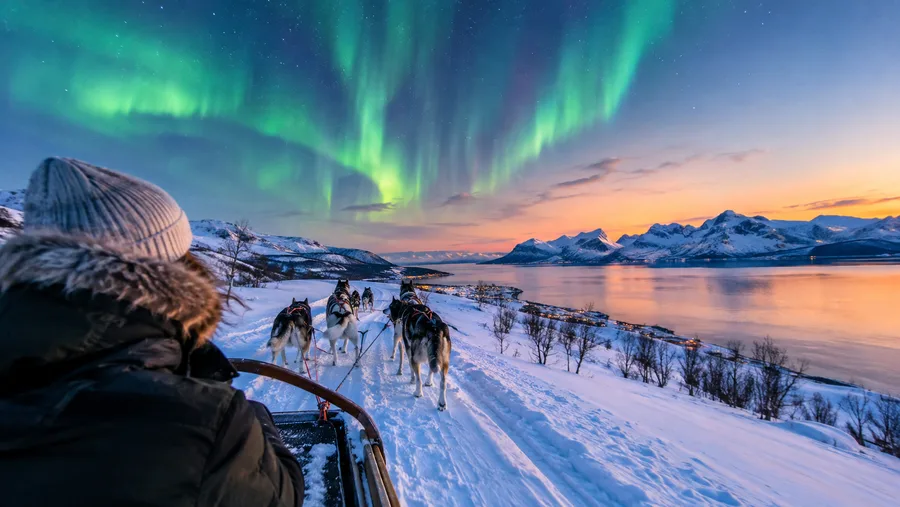
Tromso sits on an island, but the sledding trails are on the surrounding mainland or larger neighboring islands. The terrain shapes the whole experience. On Kvaloya, you are often sledding through rolling coastal plateaus with views down toward fjords. The maritime light gives the landscape a silvery glow, and the drive from the city center is brief, usually around 40 minutes. It makes for an easier, quicker evening, which suits families or those short on time.
Out in the Signaldalen or Tamok valleys, the mountains tower vertically above the trails like black fortresses against the starfield. The snow here tends to be drier, lighter, and more powdery than the damp coastal pack. Because these valleys are situated away from the open sea, they enjoy far more clear nights per winter season. The trade-off is a 75- to 90-minute bus transfer each way, turning a four-hour excursion into a seven-hour journey.
Breivikeidet provides a middle ground. Located about 50 minutes east of Tromso, it features a broad river valley framed by the Lyngen Alps in the distance. The trails here are relatively flat and open, making them ideal for nervous drivers or people who want an easier physical experience. The open flats also give you wide-angle, unobstructed vistas of the northern sky, which is exactly what you want when hunting auroras.
Whichever location you select, the routine at the finish is similar. You anchor the sleds, unharness the dogs, thank them with belly rubs, and walk into a warm hut or lavvu. Sitting on benches draped in sheepskins around a roaring birch fire, guides serve steaming bowls of bidos - a rich, traditional reindeer stew with potatoes and carrots - alongside warm berry juice. It is here, thawed out and cradling a hot mug, that travelers usually end up swapping stories about the green flares they saw crossing the sky above the trail.
Frequently Asked Questions about northern lights dog sledding tromso
What happens if the northern lights don't show up during my tour?
The tour continues as an authentic night dog sledding adventure. Operators cannot control solar activity or cloud cover, so refunds are not issued for lack of auroras. Sledding under stars in the quiet Arctic wild is still an extraordinary experience on its own.
Can I bring a camera and tripod on the sled?
You can bring a small camera or phone tucked inside your suit, but large tripods are nearly impossible to manage on moving sleds. Some sleds have space to wedge a folded travel tripod in the basket, but you will only be able to set it up during designated trail stops or back at the kennel camp.
Is night dog sledding safe for beginners?
Yes. Guides lead the trail on snowmobiles or lead sleds, and the dogs naturally follow the team in front of them. The sleds are equipped with reliable foot brakes that allow you to control speed easily, though you must stay alert and hold firmly to the handlebar at all times.
Quick Reference
- Season runs from November to early April
- Tours last 4 to 7 hours including road transfers
- Typical costs range from 2,150 to 2,650 NOK
- Thermal suits and heavy boots provided by kennels
- Both self-drive and passenger formats available
Book your dog sledding tromso experience:
My Take
If your sole goal in Tromso is getting a flawless, long-exposure photograph of the northern lights for your wall, book an aurora chase bus with a professional photographer instead. Sledding is bumpy, active, and cold. But if you want to remember what northern Norway feels like in your bones, running dogs in the dark is unbeatable. The sound of panting huskies moving through deep snow while green light shimmers faintly above frozen peaks is worth every bit of frost on your eyelashes.
Read more about dog sledding tromso.